Crawl Space Dehumidifier Guide: How to Choose the Right One
Sizing, drainage, and the features that actually matter for a damp Delmarva crawl space.
If your crawl space feels damp, smells musty, or carries that heavy summer mugginess, a crawl space dehumidifier is usually the fix. Before you buy one or ask a contractor to quote it, it helps to know what separates the right unit from the wrong one. This guide walks you through how to choose, the way we would if we were standing in your crawl space with you: by size, by drainage, and by the handful of features that truly matter.
A dehumidifier pulls moisture out of the air and holds your crawl space in a healthy range. For most Delmarva homes that target is 30 to 50% relative humidity, which is simply how much moisture the air is holding compared to how much it could hold. Stay in that band and you keep mold, wood rot, and that musty smell in check.
You do not have to decide everything today. When you are ready, FLC Energy can confirm the right size and setup with a free inspection, and our crawl space and basement dehumidifier services page covers the units we recommend.
Here is what we will cover:
- Why a crawl space needs a dehumidifier
- How to size one (cubic footage and pints per day)
- Drainage options (gravity drain vs condensate pump)
- The key features checklist
- Standalone unit vs a whole-system approach
- A quick comparison table to help you decide
Why Your Crawl Space Needs a Dehumidifier
On the Delmarva Peninsula, humidity is the default setting for about half the year. Warm, moist air drifts into a vented crawl space, meets the cooler surfaces down there, and condenses into water on your framing, ductwork, and insulation. Left alone, that moisture leads to mold, wood rot, buckling floors, pests, and higher energy bills.
Here is the part most homeowners miss: the air in your crawl space does not stay in your crawl space. Because of the stack effect (warm air rising and pulling replacement air up from below), up to half of the air you breathe on your first floor started in the crawl space. A damp crawl space is a whole-home air quality problem, not just a storage problem.
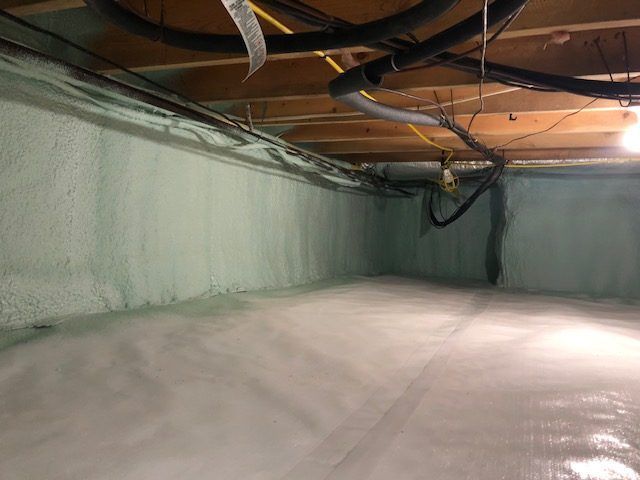
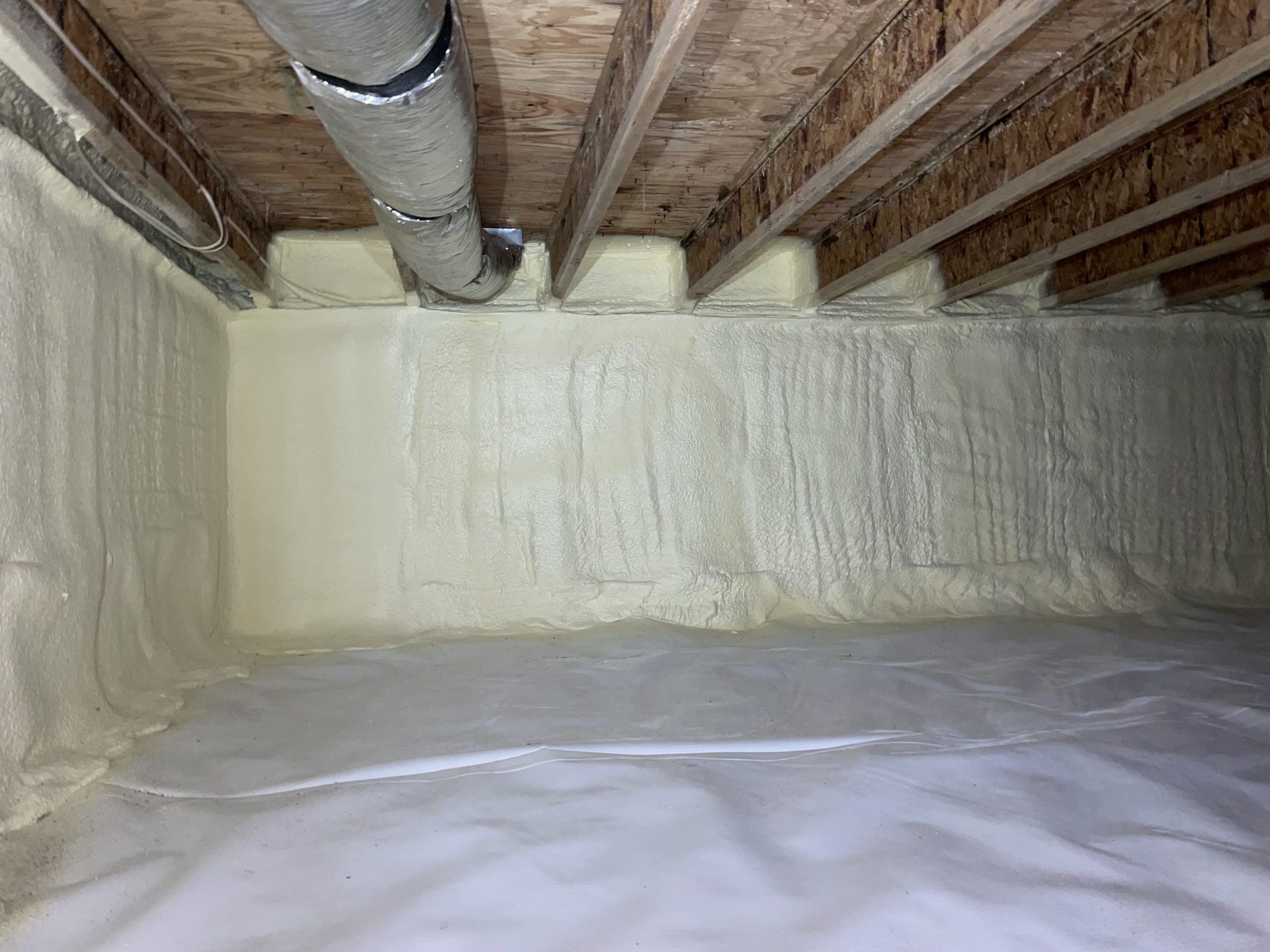
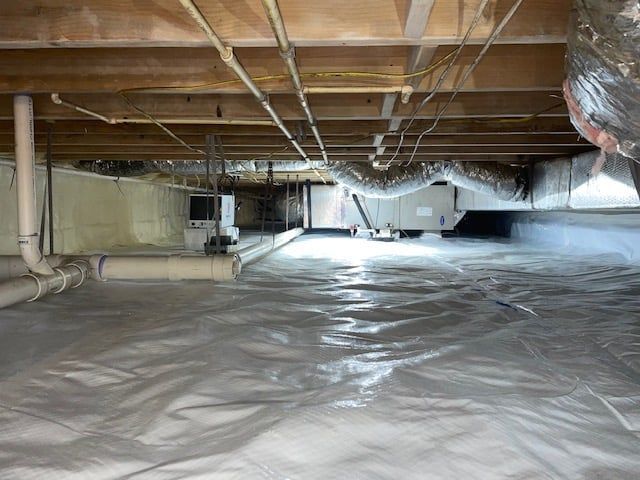
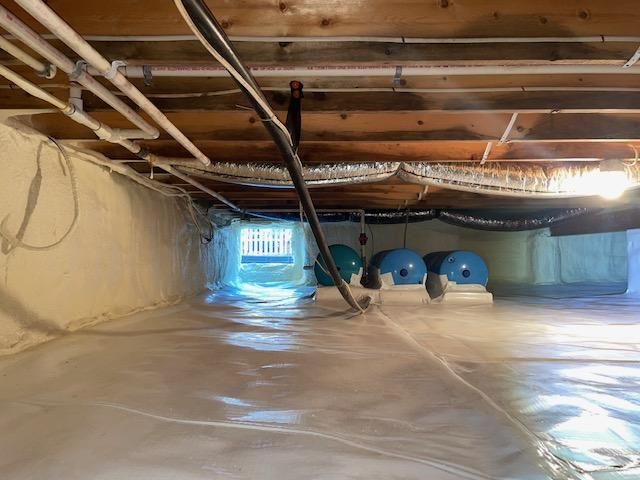
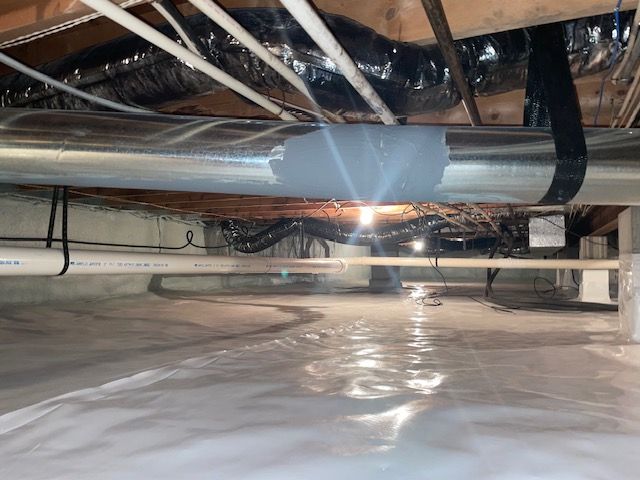
A dehumidifier solves the piece that sealing alone cannot. A vapor barrier and encapsulation block new moisture from getting in; a dehumidifier removes the moisture already in the air and keeps the space locked at 30 to 50% relative humidity year-round. In most Delmarva crawl spaces you want both. You can read how the sealing side works on our crawl space encapsulation page. Our humidity control page shows how the pieces work together.
Relative humidity (RH): the percentage of moisture in the air compared to the most it can hold at that temperature. Above 60% invites mold; 30 to 50% keeps a crawl space dry and healthy. That matches EPA guidance: keep RH below 60%, ideally 30 to 50%.
How to Size a Crawl Space Dehumidifier
Sizing is where most DIY purchases go wrong. Too small and the unit runs nonstop and never catches up. Too large and you pay for capacity you do not use. Two numbers drive the decision: your crawl space volume and the unit’s pints-per-day rating.
Step 1: Measure your crawl space (cubic footage)
Multiply length by width by average height to get cubic feet. A 1,500-square-foot crawl space with a 3-foot height is 4,500 cubic feet. Write that number down; it is the single most useful figure a contractor will ask for.
Step 2: Match it to pints per day
Pints per day (PPD): how much water a dehumidifier removes from the air in 24 hours. Higher PPD means more moisture-removal power.
Crawl-space-rated units carry higher capacity and tougher components than a portable unit you would set in a bedroom. As a rough starting point:
- Smaller, drier, or already-sealed crawl spaces often do well with a lower-capacity professional unit.
- Larger, vented, or visibly wet crawl spaces need a higher-capacity unit to keep up.
Moisture load matters as much as size. A sealed, encapsulated crawl space holds less moisture than an open, vented one of the same size, so it can use a smaller unit. That is why we size from an inspection, not a chart alone. On Delmarva, our minimum recommendation is typically the AprilAire E070, rated at 70 pints per day; larger or wetter crawl spaces step up to higher-capacity AprilAire units.
Example: a 4,500-cubic-foot vented crawl space with standing moisture needs more pints-per-day capacity than the same space after encapsulation. Sizing to the “after” condition saves you money and runtime.
Rule of thumb: when in doubt, size up slightly. A unit with a little headroom cycles less, lasts longer, and holds humidity steadier than one running at its limit.
Drainage Options: Gravity Drain vs Condensate Pump
A crawl space dehumidifier constantly pulls water out of the air, so it has to send that water somewhere. This is the detail people forget, and it is the one that decides whether your unit runs maintenance-free or quits on you in August.
Condensate: the water a dehumidifier pulls out of the air. It has to drain continuously, which is why these units are plumbed, not emptied by hand like a portable bucket model.
Gravity drain
If your crawl space has a floor drain, a sump, or a low exit point below the dehumidifier, the condensate can flow downhill on its own. Gravity drains are the simplest, lowest-maintenance option because there are no moving parts. They only work when there is somewhere lower for the water to go.
Condensate pump
Most Delmarva crawl spaces do not have a convenient low drain. A crawl space dehumidifier with a pump, whether built in or added as a separate condensate pump, collects the water and pushes it up and out, to a sump, an exterior line, or a drain above the unit. It is the right call whenever gravity will not do the job.
The tradeoff: a pump is a moving part, so it needs occasional servicing to keep running cleanly. Keeping the pump and drain line clear is part of routine upkeep. You can see how we handle that on our maintenance and condensate pump servicing page.
Key Features to Look For (Checklist)
Once size and drainage are sorted, these are the features that separate a unit that lasts from one that struggles in crawl space conditions:
✔ Built-in humidistat: sets your target humidity and cycles the unit automatically (a humidistat is a thermostat for moisture).
✔ Crawl-space-rated capacity: built for low, tight, dusty, temperature-swinging spaces, not a repurposed room unit.
✔ Auto-defrost: keeps the coils from icing up when the crawl space gets cold, so the unit keeps working in winter.
✔ ENERGY STAR efficiency: removes more water per kilowatt-hour, which matters for a unit that may run for months.
✔ Drainage matched to your space: gravity or pump, chosen for your actual layout.
✔ Washable or MERV-rated filter: cleaner air and a longer-lasting unit.
✔ Durable, sealed housing: stands up to the moisture and dust of a working crawl space.
✔ Remote or app monitoring: nice to have; check humidity without crawling under the house.
FLC installs AprilAire dehumidifiers for exactly these reasons: they are engineered for crawl space and basement conditions and hold the 30 to 50% range reliably.
Standalone Unit vs Whole-System Moisture Control
A dehumidifier can work on its own, but it performs best as one piece of a complete moisture-control system. Here is how to think about it.
A standalone dehumidifier makes sense when your crawl space is already sealed or encapsulated, the vapor barrier is in good shape, and you mainly need to pull down airborne humidity. The unit has a manageable moisture load and holds the space easily.
A whole-system approach pairs the dehumidifier with a vapor barrier and encapsulation, which block ground and outside moisture while the dehumidifier handles whatever is left in the air. Together they keep the space dry with far less runtime than a dehumidifier fighting an unsealed crawl space alone. For most Delmarva homes with a vented or damp crawl space, this is the setup that actually solves the problem.
Weighing cost? It helps to see the full picture. Our crawl space encapsulation cost guide breaks down what a complete moisture-control system runs on Delmarva and what drives the price.
Lowering the cost: Delmarva rebates
Energy-efficiency upgrades that improve your home’s moisture and comfort may qualify for utility rebate programs. In Maryland that is Delmarva Power Home Performance with ENERGY STAR; in Delaware, Energize Delaware Home Performance with ENERGY STAR. Eligibility depends on your home and the scope of work, which we confirm during the inspection.
Which Setup Fits Your Crawl Space? (Comparison)
| Setup | What it controls | Best for | Drainage usually used | Relative investment |
|---|---|---|---|---|
| Standalone dehumidifier | Airborne humidity only | Crawl spaces already sealed or encapsulated | Gravity drain or condensate pump | Lowest |
| Dehumidifier + vapor barrier | Airborne humidity + ground vapor | Partly sealed spaces needing added protection | Condensate pump (common) | Moderate |
| Full encapsulation + dehumidifier | Ground, outside, and airborne moisture | Vented, damp, or musty Delmarva crawl spaces | Condensate pump (typical) | Highest, most complete |
Investment levels are relative; your actual quote depends on crawl space size, condition, and drainage. We provide exact numbers after a free inspection.
The Bottom Line
Choosing a crawl space dehumidifier comes down to four decisions:
✔ Size it to your space: match cubic footage and moisture load to the right pints-per-day rating, and size up slightly when unsure.
✔ Plan the drainage: gravity drain if you have a low exit point, a condensate pump if you do not.
✔ Check the features: humidistat, auto-defrost, ENERGY STAR, crawl-space-rated build, and the right filter.
✔ Decide standalone vs system: a dehumidifier alone for an already-sealed space, or paired with a vapor barrier and encapsulation for a vented or damp one.
Get those four right and your crawl space stays in the 30 to 50% range, your floors and framing stay sound, and the air upstairs stays cleaner.
FLC Energy has done this across Delmarva for 32 years, and we are BPI Gold Star certified, so the sizing and setup are based on how your whole house behaves, not a guess.
Not Sure Which Dehumidifier Fits Your Crawl Space?
You do not have to work out pints per day and drainage on your own. We will inspect your crawl space, measure the real moisture load, and recommend the right AprilAire unit and setup for your home, with no obligation.
Book a free inspection: #CallFLC at (410) 860-8410
Or request a free quote online and see exactly what your crawl space needs. Ready to move forward? Explore our crawl space and basement dehumidifier services or #CallFLC at (410) 860-8410.
Frequently Asked Questions
What size crawl space dehumidifier do I need?
Size depends on two things: your crawl space volume (length x width x height in cubic feet) and its moisture load. A sealed or encapsulated space needs less capacity than an open, vented one of the same size. As a rule, size up slightly so the unit cycles instead of running flat out. The most accurate answer comes from an inspection, which FLC offers free across Delmarva.
Do I need a condensate pump or can I use a gravity drain?
Use a gravity drain if your crawl space has a floor drain, sump, or low exit point below the unit, since the water can flow out on its own. If there is no low drain, you need a condensate pump to push the water up and out. Most Delmarva crawl spaces use a pump.
Can I just put a regular household dehumidifier in my crawl space?
It is not recommended. Portable room units are not built for the low temperatures, tight access, dust, and continuous runtime of a crawl space, and they rely on a bucket you have to empty by hand. A crawl-space-rated unit is built for the conditions, drains continuously, and holds humidity far more reliably.
What humidity level should a crawl space stay at?
Between 30 and 50% relative humidity. Below that is unnecessarily dry; above 60% invites mold and wood rot. A dehumidifier with a built-in humidistat holds the space in that healthy band automatically.
Do I need encapsulation too, or just a dehumidifier?
If your crawl space is already sealed and the vapor barrier is sound, a dehumidifier alone may be enough. If it is vented, damp, or musty, pairing the dehumidifier with a vapor barrier and encapsulation controls far more of the moisture and lets the unit run less. We confirm which you need during the inspection.
Recent Posts